
Lines and Angles
Geometry is the mathematical study that deal with shapes, directions, distances, and turns etc. Lines and angles are Basic Parts of Geometry.
1. Line
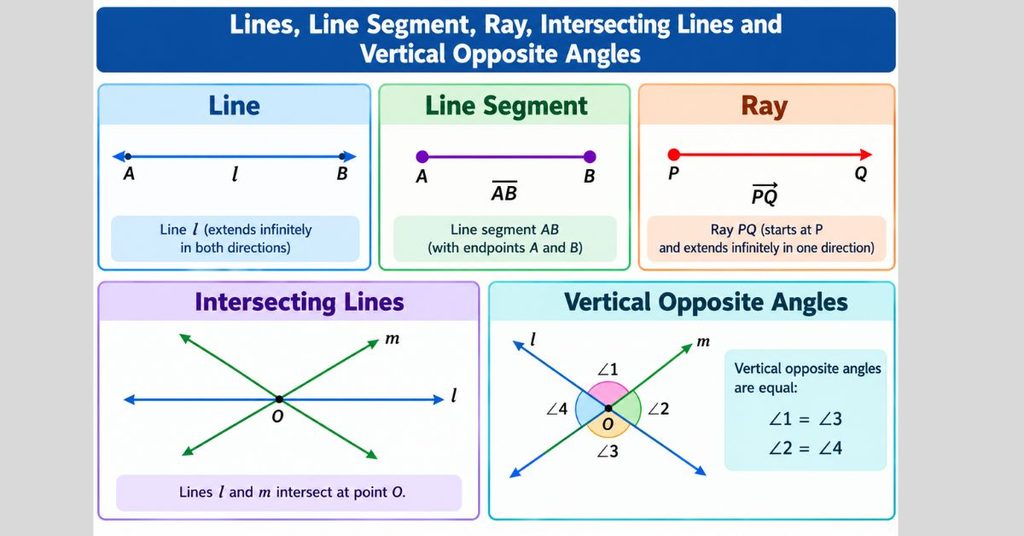
A line is a perfectly straight path that proceeds/exceed without limit in both directions. It has neither a beginning nor an ending point.
Arrowheads placed at both end indicate that the line continues indefinitely.
Essential Features
- A line has no endpoints.
- It extends indefinitely in both directions.
- Any two points lying on it may be used to identify the line.
2. Line Segment
A line segment is a bounded portion of a line enclosed by two fixed endpoints.
Unlike a line, which stretches without limit, a line segment possesses a measurable and definite length.
Diagram
A ●────────────────────────● B
          Line Segment AB
Here, A and B mark the endpoints.
The line segment may be denoted by AB or BA.
Everyday Example
The straight edge of a ruler can be regarded as a familiar example of a line segment because it has two definite ends and a fixed length.
3. Ray
A ray is a portion of a line that begins at one fixed point and proceeds indefinitely in a single direction.
Diagram
A ●───────────────────────────►                                                                          B
   Endpoint
The ray originates at A and continues endlessly through B.
It is written as Ray AB.
Naming Rule
When a ray is named with two letters, the first letter must identify its endpoint.
Thus, Ray AB begins at A, whereas Ray BA begins at B.
4.Intersecting Lines
Two lines are known as intersecting lines when they meet at a common point.
The location at which they meet is called the point of intersection.
5. Vertically Opposite Angles
When two lines cross, four angles are produced around their point of intersection.
The pairs positioned directly opposite one another are called vertically opposite angles.
Fundamental Rule
Vertically opposite angles are always equal.
If one of these angles measures 75°, the angle directly across from it also measures 75°.
Chapter : Lines and Angles
6. Angle and its types
An angle is created when two rays emerge from the same endpoint.
The shared endpoint is known as the vertex, while the two rays forming the angle are its arms.
Diagram
                 B
                ●
               /
              /
             /
            /
           ● O────────────────● A
         Vertex             Arm OA
             \
              \
               \
                Arm OB
In this figure:
- O is the vertex.
- OA is one arm.
- OB is the other arm.
- The angle may be named ∠AOB or ∠BOA.
Naming Rule
When an angle is expressed using three letters, the vertex must occupy the middle position.
Types of Angle:
7. Acute Angle
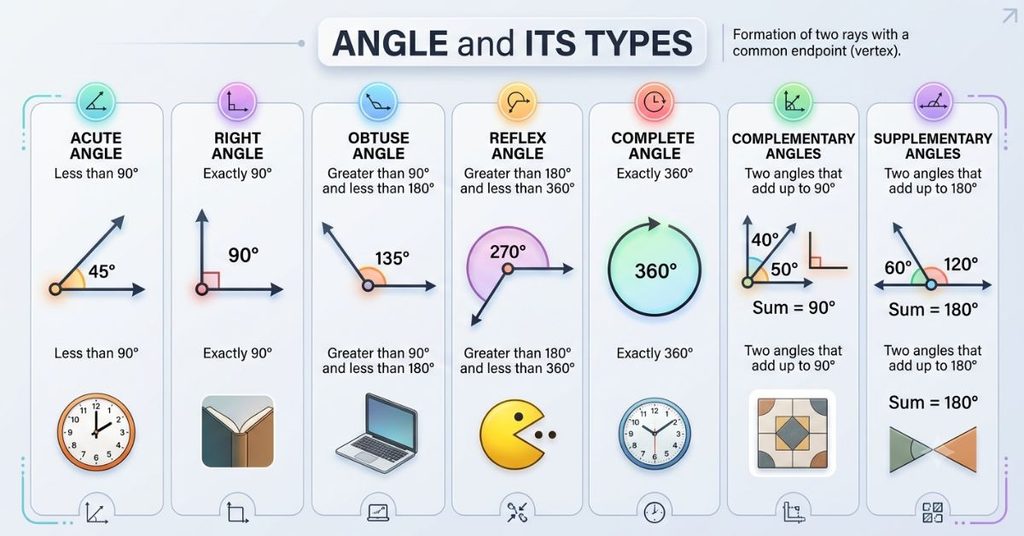
An acute angle whose measures is more than 0° but less than 90°.
Rule
0° < Acute Angle < 90°
8. Right Angle
A right angle has an exact measure of 90°.
Familiar Examples
Right angles occur at the corners of:
- Books
- Squares
- Rectangular tables
- Rooms
9. Obtuse Angle
An obtuse angle is whose measure is greater than 90° and less than 180°.
Rule
90° < Obtuse Angle < 180°
10. Straight Angle
A straight angle measures exactly 180°.
Its two arms point in precisely opposite directions, producing the appearance of a straight line.
11. Reflex Angle
A reflex angle measures more than 180° but less than 360°.
When two rays form a reflex angle, the larger rotational region around the vertex is considered, rather than the smaller opening between the rays.
Rule
180° < Reflex Angle < 360°
12. Complete Angle
A complete angle measures exactly 360°.
It represents one entire revolution around a point.
Imagine a ray beginning at O, rotating through a full turn, and eventually returning to its original position. The total rotation is 360°.
13. Comparison of Angle Types
| Type | Measurement |
|---|---|
| Acute angle | Greater than 0° and less than 90° |
| Right angle | Exactly 90° |
| Obtuse angle | Greater than 90° and less than 180° |
| Straight angle | Exactly 180° |
| Reflex angle | Greater than 180° and less than 360° |
| Complete angle | Exactly 360° |
14. Adjacent Angles
Two angles are described as adjacent angles when they sit beside one another and satisfy several conditions:
- They possess the same vertex.
- They share one arm.
- Their remaining arms lie on opposite sides of the common arm.
- Their interiors do not overlap.
15. Complementary Angles
Two angles are complementary angles when their measures together total 90°.
Example
Suppose the two angles measure 30° and 60°.
30° + 60° = 90°
Hence, they form a pair of complementary angles.
Important Point
Complementary angles do not necessarily need to be adjacent. Their defining feature is simply that their measures have a combined value of 90°.
16. Supplementary Angles
Two angles are supplementary angles when their combined measure is exactly 180°.
For example:
120° + 60° = 180°
Therefore, 120° and 60° are supplementary.
In the particular diagram below, the two angles together constitute a straight angle.
Important Point
Supplementary angles need not always be adjacent. Their essential requirement is that their measures total 180°.
Chapter : Lines and Angles
Trending News : Check Govt Jobs 2027
Join Our WhatsApp Group For Latest Study Notes And Govt Jobs
17. Parallel Lines
Two lines are parallel when they remain in the same plane and do not meet, even if both are extended indefinitely.
Their separation remains constant.
Diagram
Line l:

A ●─────────────────────● B


Line m:

C ●────────────────● D
The relationship is written as:
l ∥ m
The symbol ∥ signifies “is parallel to.”
Familiar Examples
- Railway tracks
- Opposite sides of a rectangle
- Lines printed on ruled paper
18. Transversal
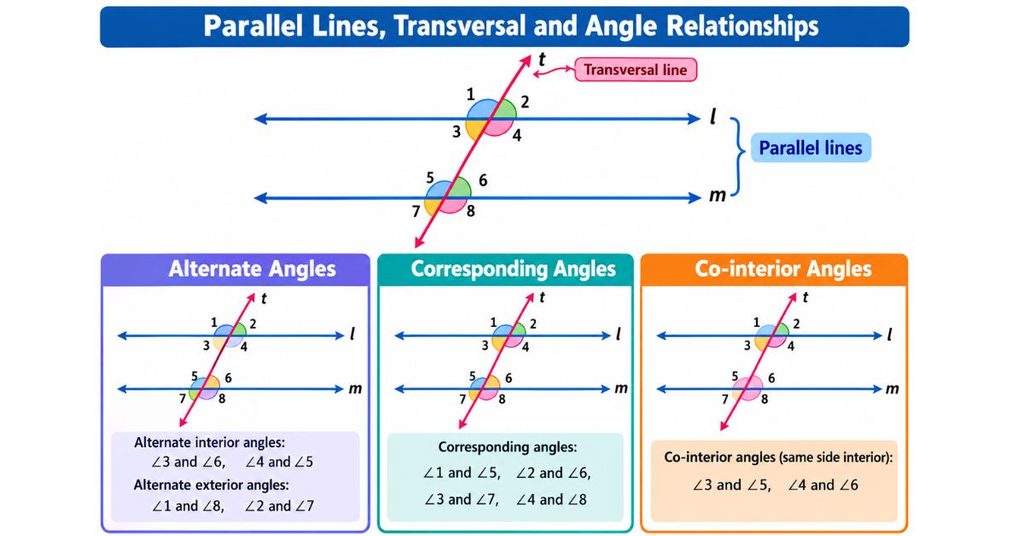
A transversal is a line that intersects two or more other lines at distinct points.
19. A Transversal Cutting Two Parallel Lines
Consider two parallel lines, l and m, crossed by a transversal t.
l ∥ m
The space enclosed between the two parallel lines is the interior region.
The portions beyond the two parallel lines are the exterior regions.
20. Corresponding Angles
Corresponding angles occupy the same relative position at the two points where a transversal intersects two lines.
The essential idea is simple: if one angle occupies a particular corner at the first intersection, its corresponding partner occupies the equivalent corner at the second intersection.
21. Alternate Interior Angles
Alternate interior angles satisfy two conditions:
- They lie between the two lines.
- They are positioned on opposite sides of the transversal.
22. Alternate Exterior Angles
Alternate exterior angles lie beyond the two lines and occur on opposite sides of the transversal.
Chapter : Lines And Angles
23. Co-Interior Angles
Co-interior angles, also called same-side interior angles, occupy the region between the two lines while remaining on the same side of the transversal.
They:
- Lie inside the two lines.
- Remain on the same side of the transversal.
Rule
When two lines are parallel, co-interior angles have a combined measure of 180°.
Chapter :Lines and Angles
24. The Four Important Transversal Relationships
Suppose:
l ∥ m
                         t
                        /
                       /
              1       /       2
─────────────────────●───────────── l
              3     /       4
                   /
                  /
              5  /       6
────────────────●───────────────── m
             7 /       8
              /
Corresponding Angles
Same relative position
- ∠1 = ∠5
- ∠2 = ∠6
- ∠3 = ∠7
- ∠4 = ∠8
Alternate Interior Angles
Inside the lines + opposite sides
- ∠3 = ∠6
- ∠4 = ∠5
Alternate Exterior Angles
Outside the lines + opposite sides
- ∠1 = ∠8
- ∠2 = ∠7
Co-Interior Angles
Inside the lines + same side
- ∠3 + ∠5 = 180°
- ∠4 + ∠6 = 180°
These relationships form the central pattern students need to recognize when a transversal intersects parallel lines.
25. A Simple Way to Remember Angle Relationships
Corresponding Angles
Think:
Same position.
A useful mental image is:
Top-left ↔ Top-left
Alternate Angles
Think:
Opposite sides of the transversal.
The word alternate suggests a change from one side to the other.
Co-Interior Angles
Think:
Same side + inside.
The word interior means that the angles occupy the region between the two lines.
Vertically Opposite Angles
Think:
Directly opposite at an intersection.
Such angles are always equal.
Chapter :Lines and Angles
26. Important Rules at a Glance
| Angle Relationship | Rule |
|---|---|
| Vertically opposite angles | Equal |
| Corresponding angles | Equal when lines are parallel |
| Alternate interior angles | Equal when lines are parallel |
| Alternate exterior angles | Equal when lines are parallel |
| Co-interior angles | Add up to 180° when lines are parallel |
| Angles on a straight line | Add up to 180° |
| Angles around a point | Add up to 360° |
| Complementary angles | Add up to 90° |
| Supplementary angles | Add up to 180° |
Chapter : Lines and Angles
27. Solved Example 1: Complementary Angles
Suppose one angle measures 35°. Determine its complementary angle.
Complementary angles have a combined measure of 90°.
Therefore:
Missing angle = 90° − 35°
Missing angle = 55°
Hence, the complementary pair is:
35° and 55°
28. Solved Example 2: Supplementary Angles
Suppose one angle measures 125°. Determine its supplementary angle.
Supplementary angles total 180°.
Therefore:
Missing angle = 180° − 125°
Missing angle = 55°
Verification:
125° + 55° = 180°
29. Solved Example 3: Vertically Opposite Angles
Two lines intersect, and one of the resulting angles measures 75°.
The angle directly opposite it is vertically opposite.
Since vertically opposite angles are equal:
Opposite angle = 75°
30. Solved Example 4: Corresponding Angles
Two parallel lines are intersected by a transversal. One corresponding angle measures 65°.
Corresponding angles are equal when the lines are parallel.
Therefore:
Corresponding angle = 65°
31. Solved Example 5: Co-Interior Angles
Two parallel lines are intersected by a transversal. One co-interior angle measures 115°.
Co-interior angles together measure 180°.
Therefore:
Missing angle = 180° − 115°
Missing angle = 65°
Verification:
115° + 65° = 180°
32. Lines and Angles in Everyday Life
Geometry is not confined to diagrams and classroom exercises. Straight paths, turns, corners, and parallel arrangements appear throughout ordinary surroundings.
Lines
- Roads
- Electric wires
- Long straight edges
- Railway tracks
Line Segments
- Rulers
- Book edges
- Table edges
- Window frames
Rays
- Light rays
- Sunlight spreading outward
- A flashlight beam
Angles
- Clock hands
- Scissors
- Open doors
- Roof structures
Parallel Lines
- Railway tracks
- Opposite sides of a rectangle
- Lines in a notebook
Right Angles
- Corners of rooms
- Books
- Screens
- Tiles
33. Final Revision of Chapter : Lines and Angles
Line
A straight path extending indefinitely in both directions.
Line Segment
A portion of a line bounded by two endpoints.
Ray
A straight path with one endpoint that continues indefinitely in one direction.
Angle
A figure formed by two rays sharing a common endpoint.
Acute Angle
Greater than 0° but less than 90°.
Right Angle
Exactly 90°.
Obtuse Angle
Greater than 90° but less than 180°.
Straight Angle
Exactly 180°.
Reflex Angle
Greater than 180° but less than 360°.
Complete Angle
Exactly 360°.
Adjacent Angles
Angles sharing a vertex and one arm without overlapping.
Complementary Angles
Angles whose measures total 90°.
Supplementary Angles
Angles whose measures total 180°.
Intersecting Lines
Lines that meet at a point.
Parallel Lines
Lines in the same plane that do not meet, even when extended indefinitely.
Transversal
A line that intersects two or more lines at different points.
Vertically Opposite Angles
Opposite angles produced when two lines intersect; they are equal.
Corresponding Angles
Angles occupying matching relative positions; they are equal when the lines are parallel.
Alternate Interior Angles
Angles situated between the two lines and on opposite sides of the transversal; they are equal when the lines are parallel.
Alternate Exterior Angles
Angles situated outside the two lines and on opposite sides of the transversal; they are equal when the lines are parallel.
Co-Interior Angles
Angles situated between the two lines on the same side of the transversal; when the lines are parallel, their measures total 180°.
Quick Memory Trick
The principal transversal relationships can be recalled through four compact ideas:
Corresponding → Same position
Alternate → Opposite sides
Interior → Inside
Co-interior → Same side + inside
Define Lines And Angles?
Ans. A line is a perfectly straight path that proceeds/exceed without limit in both directions. An angle is created when two rays emerge from the same endpoint.
Chapter : Lines And Angles : What are different types of angles?
Ans. Types of Angles: Acute, Obtuse, Right, Straight, Reflex, Complete angle.